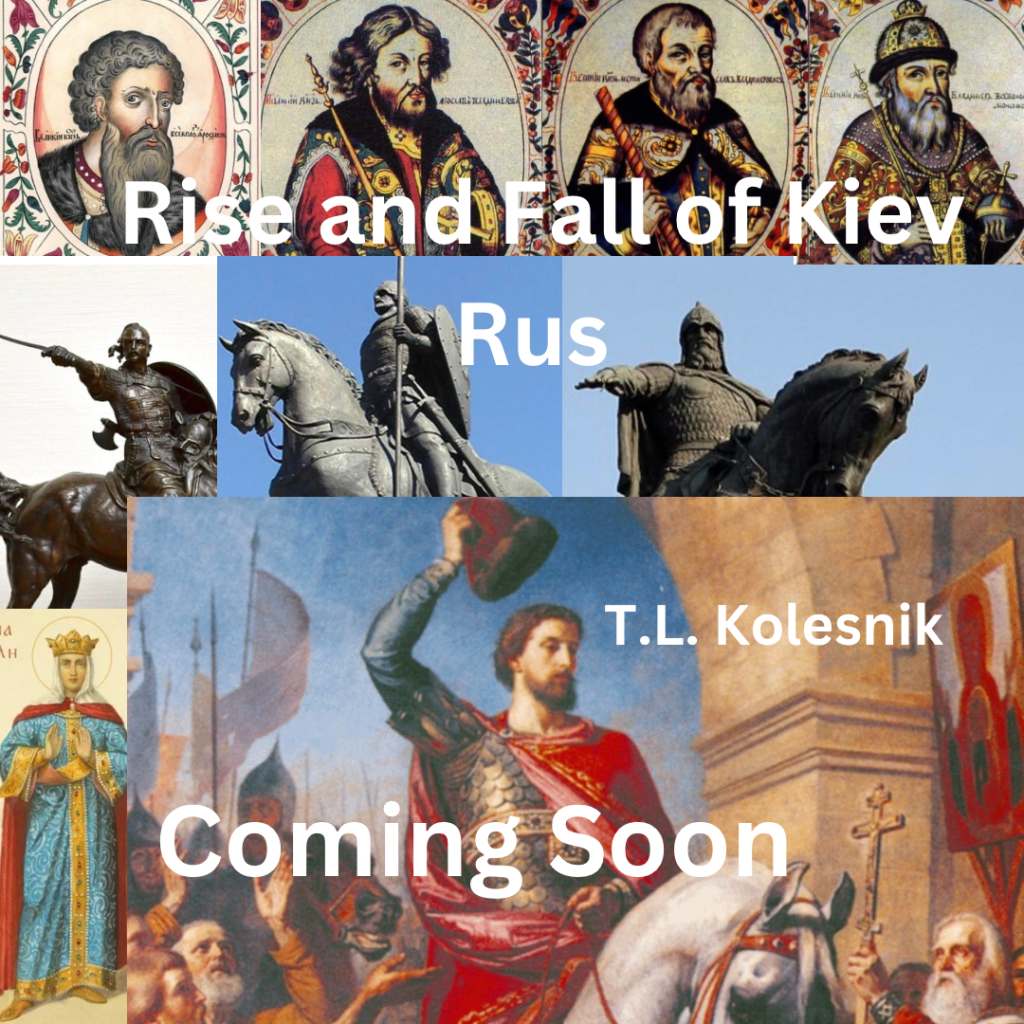
The Rise and Fall of Kiev Rus by T.L. Kolesnik
Introduction
I have always wondered what the place called Kiev Rus was like and what caused it to rise and fall. To this day, there are discussions and claims about it. Nevertheless, nothing was clear, at least for me. When I started to study it in-depth, I noticed many contradictions made by different historians during different government regimes. I was not interested in various interpretations of historians in the 18th, 19th, and later about events in 980. I wanted to know historical events and facts that took place. After studying chronicles of ancient times written in Old Slavonic and interpreted into modern Russian, I am comfortable using those texts in this project and translating them into English. Moreover, for this project, I consulted people who had spent years studying the Old Slavonic language.
In this book, I am using Russian versions of names, and I might add Ukranian versions, Polish, and others if it suits the event and to make the reference to the modern day. For those who might argue against using Russian names, I would like to remind you that the land known as modern-day Ukraine used to be part of Poland, the Russian Empire, and later the Soviet Union until Ukraine became an independent country in 1991. Therefore, to avoid confusion, I will use names that will make it easier to understand the historical events.
If you have any questions, inquiries, or concerns, please do not hesitate to contact me: tlkolesnik@yahoo.com
Stay tuned and visit http://www.taia-books.com website as I work on my next history project.
Chapter 1
Chapter 1 Kiev Rus (882-1240)
There is a myth that Vikings established or founded Kiev Rus.
The period known as Kiev Rus officially started in 882 and ended in 1240 with the invasion of the Mongol’s destruction of Kiev.
Kiev Rus began with Ladoga up north (Russia), a Slavic northern town that originated in 700 on Lake Ladoga shore, which served as a trade center with Scandinavian, Baltic, and German merchants. Glass-made coins dating 738, 739, and 786 show robust international commerce until the invasion of Vikings during the Viking Age in 800 devastated the settlement with a massive fire. According to the chronicles, Rus worriers “threw Vikings behind the sea and refused to pay them. But the tribes stopped having truth among themselves, and kin went on kin, and they waged wars among themselves.” The tribes called for Veche to gather all the representatives and decide what to do. They sent envoys to the Vikings and invited them to the land to contain peace among tribes and protect the land for rewards. Veche is a gathering of the people in Slavic tribes. All free residents of the tribe could attend and participate in Veche to choose a new administrator, knyaz, remove administrators, declare war or make peace, seek justice, and more. In a situation where a husband was deceased, a wife could attend instead of him.
Rurik (862-879)
According to the chronicles, in 862, a Viking named Rurik, along with his two brothers, was invited by the tribes of Sloven, Krivichi, Chud, Vis, and others to fight the wars for them. Rurik arrived in Ladoga and later moved to Novgorod in 864.
Novgorod was the second largest city during the Kiev Rus. It was founded in 859 before the arrival of Rurik. Novgorod was split into two sides by River Volhov. It started with small settlements in the 700s, consisting of mixed tribes: Slavic, finno-urgur, Baltic people, and more.
A word to know: Knyaz- Slavic word for a man on a horse in charge of an army and more.
Rurik died in 879. In 882, Knyaz Oleg the Ancient, a regent over Rurik’s underage son Igor, went on to Kiev with the Novgorod army, captured it, made Kiev the main seat, and “the mother of the Russkiy cities,” as stated in the chronicles. Since then, all older sons of a knyaz had a tradition of managing Novgorod- the second influential city until they inherited Kiev and became in charge of other knyazes.
Word to know: Russkiy is an adjective for Rus. Used in describing residents of Rus, language, part of the world, and more. In Old Slavic and Russian languages, Russkiy can stand alone as a noun; nerveless, there are arguments about whether it became a noun or remains an adjective. Usually, Russkiy used as a noun when describing a person.
Kiev was founded in 450, mostly by the Poliane tribe. It was conveniently located on the way to “the Greeks,” the Byzantine Empire, which served as the cradle of commerce and Christianity. Contrary to some claims, the Vikings couldn’t build Kiev or other Russian cities, as the first cities built in Scandinavia, home of Vikings, date in the 8th, 9th, and 10th centuries.
After Rurik’s death, Oleg the Ancient, a Viking, became the Grand knyaz and guardian of Igor, Rurik’s son. During that time, Oleg started exploring and expanding the territory by conquering west of Kiev land -the Drevlyane tribe in 883, which is part of the Zhytomyr region and, nowadays, Belarus. From there, he conquered northern tribes in 884 of nowadays regions of Chernigov, Summy, Bryansk, Kursk, and Belgorod regions (modern Ukraine and Russia.
After that, he went to conquer the Radimichiy tribe in 885 on the shores of Dnepr, Desni, Vitebsk, Mogilev, Gomel, Bryansk, and Smolensk (modern-day Ukraine, Russia, and Belarus).
In 898, according to the chronicles, ugric-Hungarian tribes migrated to the territory from the west. Oleg visited the Byzantine Empire and signed a treaty. According to the chronicles, Oleg the Ancient died from a snake bite in the autumn of 912.
Igor is the first knyaz born in 878 in Rus, grew up under the guardianship of his relative Oleg, and became known as the founder of the Rurik dynasty. After Oleg’s death in 912, he became a knyaz of Kiev Rus. In 914, Igor visited Drevliane and put on them more considerable taxation than during Oleg. In 941, he made an excursion into Byzantine. In 942, Igor had a son, Svyatoslav, with his wife Olga. In 945, Igor grew upset over the taxation he received from Drevliane, and went with his soldiers to humble them. On his way home, he told his soldiers to head home and, with less army, returned to collect more taxes. However, Drevliane, on seeing him, said that he came “as a wolf to the sheep and he would come until he’s killed.” According to the chronicles, “he was captured and killed in Drevliane land and buried there to this day”. His son Svyatoslav was three when his mother, Olga, became his regent. Igor was 67 when he died.
Olga (945-960)
Olga was born into a Slavic family in Pskov, a northern city in Rus. Some historians think that she was Oleg’s daughter, and he married her to Igor. According to the chronicles, there is a story about a meeting between Olga and Igor. Igor walked into a water taxi boat and noticed that a girl controlled the boat. He started to harass her.
“Why are you bothering me, Knyaz, with immodest words? Yes, I’m young and not influential, and I’m by myself, but I know that it’s better for me to jump into the river than suffer indecency,” Olga said to him, and Igor grew quiet. When the time came for Igor to choose a wife, he remembered Olga and married her. When Igor died, Igor’s warriors recognized her as the lawful regent of the underage knyaz.
After her husband’s death, Olga received an envoy of about 20 Drevliane elders offering her to marry their Knyaz Mala. Olga killed them by burying them alive. She went on revenging Drevliane region, attacking them with her warriors and killing many people.
In 945, Olga set the rates on taxation, dates of collection, and policies. The Kiev Rus territory became split into regions and managed by administrators. She set up centers of trade and commerce and ordered the gathering of taxes there. Also, Knyaginay (Knyaz’s wife) Olga started building palaces and government buildings from stones instead of wood. She visited other regions of the Kiev Rus to observe the growth and development.
In 955, Olga visited Constantinople, the capital of the Byzantine Empire, and converted from Slavic paganism to Orthodox Christianity. She was baptized with a new name, Elena. Upon her return to Rus, she started telling her son Sviatoslav about Christianity, but he refused to listen. “He didn’t forbid baptism of others but made fun of them.” He became angry at his mother for telling him about Christianity, being afraid to lose the respect of his warriors.
In 960, Sviatopolk became the ruling Knyaz, and in 969, Olga passed away at old age (possibly 80). Her son and grandsons and all the people sobbed for her. She was buried by a Christian tradition. In 1007, her grandson Knyaz Vladimir I moved her to a church he built, the Church of the Holy Mother of God in Kiev.
“She was a missionary of Christianity, like a dawn before the sun. She shined like a moon at night among pagans, like a pearl in mud,” wrote an unknown about her. From taxes, she built churches, used the money to evangelize the people of Kiev Rus, and gave food to the poor.
 TAIA Books